Part IV
Stay on top.
A growing business has more to keep track of every week. Part IV is about seeing what matters quickly, letting routine work run by itself, and connecting your tools so nothing falls between them.
18 · Stay on top
The weekly business review
Thirty minutes, once a week, with the same five questions. It's the habit that keeps everything else working.
What good looks like:
- You block the same thirty minutes every week.
- You look at the same few numbers: enquiries, jobs won, money in, reviews, open quotes.
- You check what's stuck: late replies, quiet quotes, unpaid invoices.
- You pick one thing to improve this week, and one person owns it.
- Last week's improvement gets a quick check.
Why bother
Most small problems become big ones because nobody looked in time. A short weekly review catches a drop in enquiries, a quote going cold or a bad review while it can still be fixed — and it makes the week ahead calmer.
How to do it
Ask the same five questions every week:
- How many enquiries did we get, and how many became jobs?
- What's waiting on us: replies, quotes, bookings?
- What came in and what went out?
- What did customers say this week?
- What's the one thing we'll improve, and who owns it?
a forty-tab spreadsheet nobody opens.
one page: five numbers, three things waiting, one decision.
- Enquiries
- 11
- Jobs won
- 4
- Money in
- 86k
- Reviews
- 3
- Open quotes
- 7
Waiting on us
- Reply to Hansen about the extension
- Two quotes quiet for a week
- One unpaid invoice from August
This week’s one thing
Follow up the two quiet quotes by Wednesday. Owner: Kari.
Example figures for illustration.
19 · Stay on top
Let routine work run itself
If you do the same task every week, write it down once — and let it run.
What good looks like:
- You have a list of the tasks you repeat every week or month.
- Each one has clear instructions: what to do, where, and what "done" looks like.
- Routine checks and reports run on a schedule, without you remembering them.
- You get an alert only when something needs a decision.
- Anything that goes to customers still waits for your approval.
Why bother
Repeated tasks steal hours from the work only you can do. Written-down routines are also how a business keeps running when someone is ill, on holiday or new — and they're what makes handing work to Dagny safe.
How to do it
- Write down every task you repeat for two weeks.
- Pick the three that take the most time or are most often forgotten.
- For each, write the steps, the tools and the result you expect.
- Decide what runs by itself and what needs your approval.
- Review the list once a quarter.
“I usually check the ads on Mondays if I remember.”
“Every Monday at 8: check ad spend against enquiries, flag anything that cost more than 400 kr per enquiry, and send me a short note.”
- 1Write it onceSteps, tools, what “done” means.
- 2Set approvalCustomer-facing always waits for you.
- 3Schedule itDaily, weekly or monthly.
- 4Alert only when neededQuiet weeks stay quiet.
20 · Stay on top
Your tools, connected
Each tool you connect gives Dagny more context and more work it can do. Start with the few that matter most.
What good looks like:
- Your email, calendar and Google tools are connected first.
- Each tool has clear permissions: read only, draft, or act with approval.
- You know what Dagny can see and do in each tool.
- You add tools when there's a job for them, not all at once.
Why bother
Most of the work in this playbook crosses tools: an enquiry in email, a time in the calendar, a record in the CRM, a page on the website. Connected, the work flows. Disconnected, you're the one copying things between them.
How to do it
Connect in this order:
- Your website and Google Search Console — to be found.
- Google Business Profile — to be chosen.
- Email and calendar — to answer and book.
- Analytics and ads — to see what works.
- CRM, social media, email marketing and payments — when you're ready to grow.
- 1Your website and Google Search Console — be found
- 2Google Business Profile — be chosen
- 3Email and calendar — answer and book
- 4Analytics and ads — see what works
- 5CRM, social, email marketing, payments
A good place to start
Hand over one job this week.
You've seen what good looks like. Pick a task from Things Dagny does, or tell Dagny what you want to achieve.
Take it with you
Free PDF · 51 pages
The whole playbook, in one PDF.
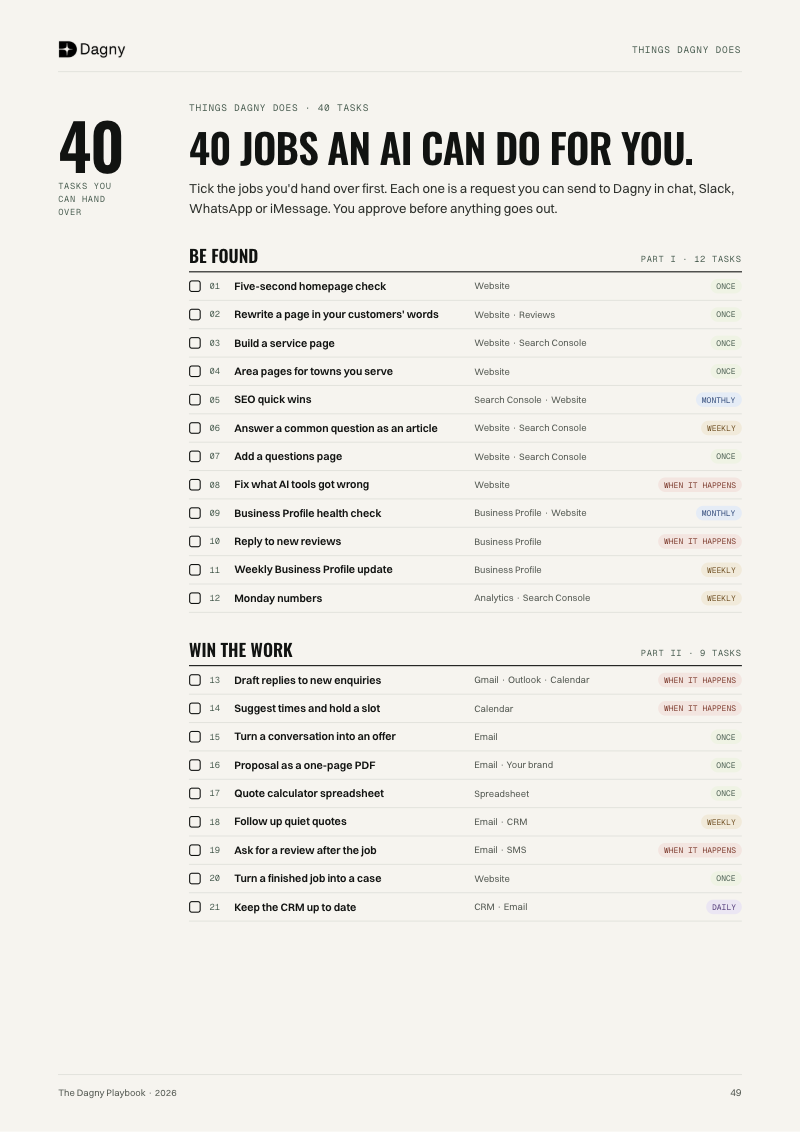
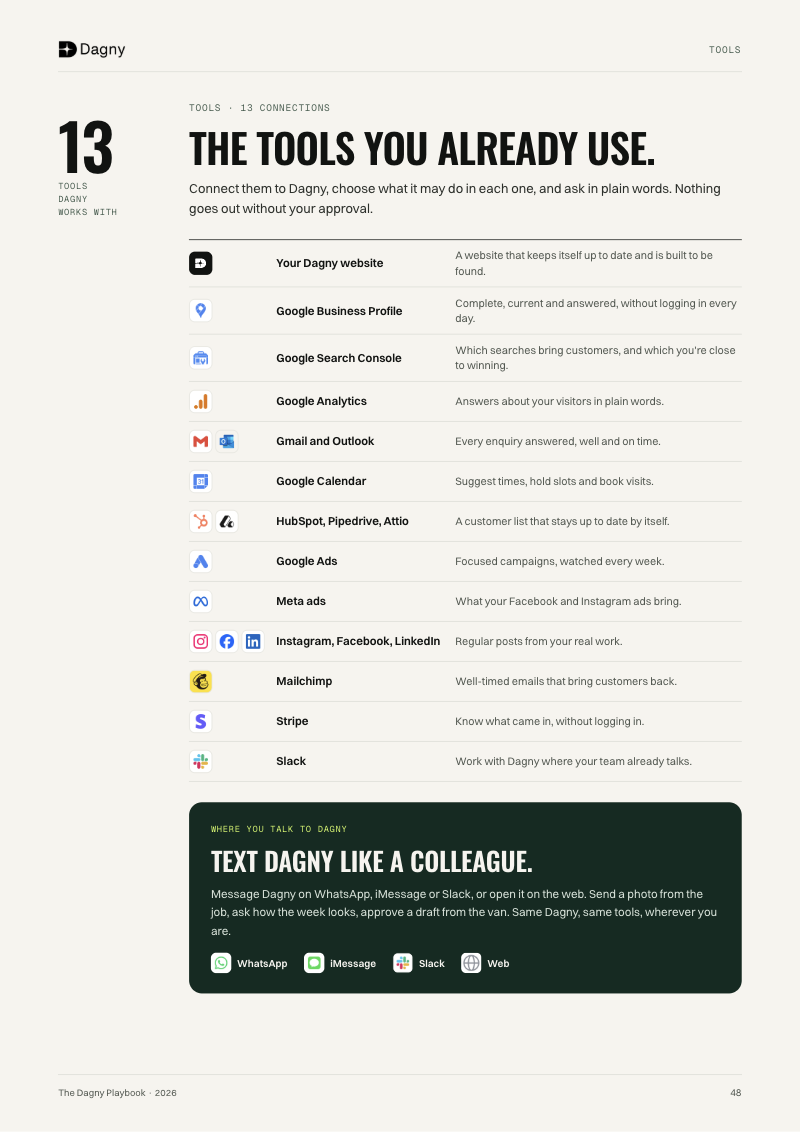
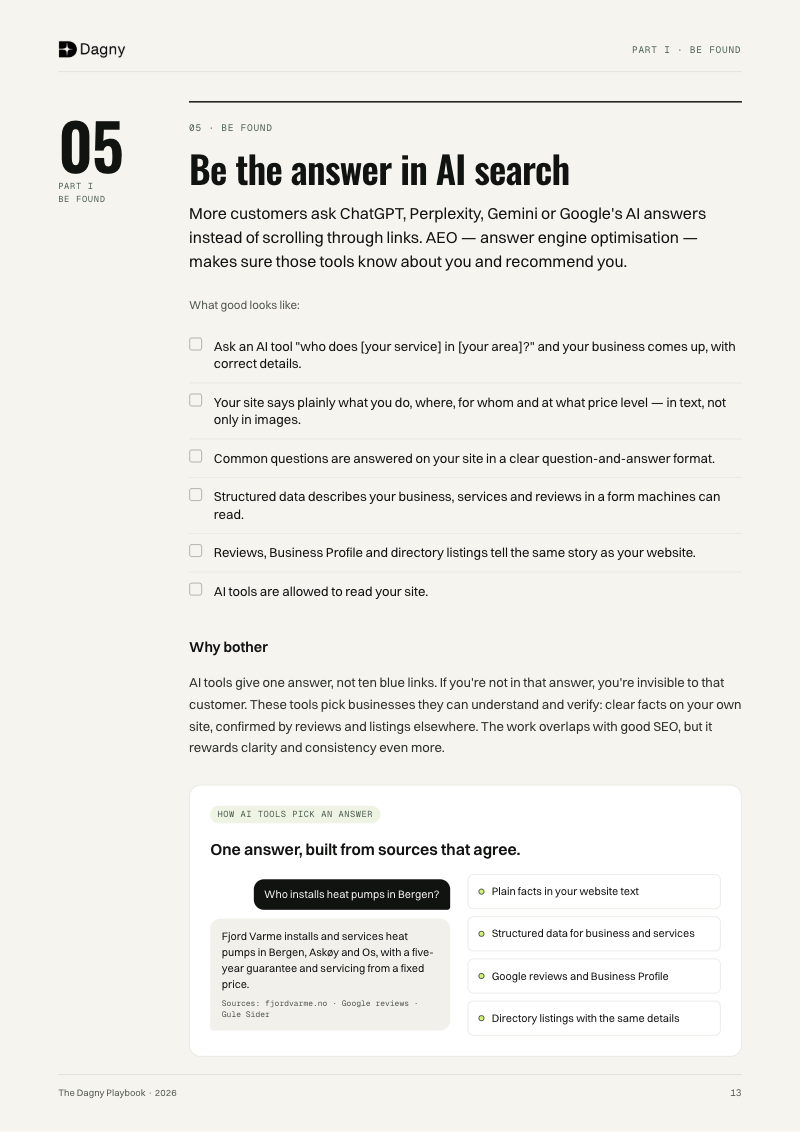
Four parts, 20 sections, the worksheets and the 40-task checklist. Read offline, print, or pass it on.51 pages to read offline, print, or pass on to your team.