Part II
Win the work.
Being found only matters if the people who find you get in touch — and get a reply that makes them want to go ahead. Part II covers contact, replies, offers, follow-up and reviews: the work between the first message and the signed job.
08 · Win the work
Make it easy to get in touch
Every extra step between "I want this" and "I've asked" loses customers. Make getting in touch take less than a minute.
What good looks like:
- Your phone number is on every page, and it can be tapped on a phone.
- A short form asks only for what you need to reply: name, what they need, where, and when.
- If jobs can be booked, customers can pick a time without calling.
- You say how quickly you reply, and you keep that promise.
- Every message lands in one inbox that someone checks every day.
Why bother
Most people contact the first business that makes it easy. A long form, a hidden phone number or a "we'll be in touch" with no timeframe sends them back to Google. Small fixes here often bring more work than any amount of new traffic.
How to do it
- Put a clear button at the top of every page: "Get a quote", "Book a visit" or "Call us".
- Cut the form to four or five fields. Everything else can be asked in the reply.
- Offer the way your customers prefer: phone, form, email, and a booking link if the work can be scheduled.
- Promise a reply time next to the form, such as "We reply within four working hours."
- Test it yourself on a phone once a month. Submit the form and check where the message goes.
a contact page with one long form: twelve fields, a captcha, and no phone number.
"Get a quote. Tell us what you need and where. We reply within four working hours." Four fields, a tap-to-call number beside it, and a booking link for site visits.
SLOW
- Find page
- Scroll
- 12 fields
- Captcha
- “We'll be in touch”
FAST
- Button
- 4 fields
- “Reply within 4 hours”
- Booked
09 · Win the work
Answer every enquiry fast
The first useful reply usually wins the job. Answer the question they asked, and give them a clear next step.
What good looks like:
- Every new enquiry gets a reply the same working day.
- The reply answers what the customer actually asked.
- If you need more information, you say exactly what — a photo, a measurement, an address.
- Every reply ends with a next step and a time: a visit, a call, or a quote by a date.
- Someone is responsible for every open enquiry.
Why bother
Customers often ask two or three businesses at once. The one that replies first with a useful answer and a clear next step usually gets the visit. A slow or vague reply can lose a job you would have won on quality.
How to do it
- Read the new message and any earlier conversations with the same customer.
- Answer their question first, in their words. Then ask for anything you need.
- Suggest two or three times from your calendar.
- Record what happens next and who owns it.
- If there's no answer, follow up once with something useful — not "just checking in".
“Thanks for your enquiry. We will get back to you.”
“Before we update the quote, could you send a photo of the garage and the route from the fuse board? We can then confirm whether a site visit is needed. Thursday at 10 or Friday at 14 both work for us.”
Hi, we got the driveway quote. Could you also put a charger in the garage?
DAGNY’S DRAFT · WAITING FOR YOUR OK
Yes, we can. Could you send a photo of the garage and the route from the fuse board? Thursday at 10 or Friday at 14 both work for a quick look.
- ✓ You approve
- Customer picks Friday
- Visit booked
10 · Win the work
Offers and proposals customers understand
A clear offer answers every question before it's asked: what's included, what isn't, what it costs, and what happens next.
What good looks like:
- The offer fits on one page, with more detail attached if needed.
- It repeats the customer's problem in their words before describing the solution.
- Scope is clear: what's included, what isn't, and what could change the price.
- The price is easy to find, with options where it makes sense.
- There's one example of similar work, with a photo or a short review.
- It ends with the next step and a date: "Reply by Friday to keep the slot in week 42."
Why bother
Quotes usually go quiet because the customer is unsure about something, and it's easier to wait than to ask. Price is rarely the whole story. A clear offer removes the uncertainty and makes saying yes the easy option.
How to do it
- Start with what you heard: the customer's goal and the problem, in their language.
- Describe the work in plain steps, and list what's included and what isn't.
- Show the price, and if possible two options: a standard and a better one.
- Add proof: one similar job, with a photo and a short quote from that customer.
- Finish with the next step, a date, and how to say yes.
a PDF with a single total, a list of item codes and "valid for 30 days".
“You want the office cleaned before staff arrive, without changing cleaners every month. Here's what we'll do, what's included, and two options. Reply by Friday and we start on the 1st.”
- 1 · What you told us — their goal, in their words
- 2 · What we'll do — the work in plain steps
- 3 · Included / not included — no surprises
- 4 · Price and options — standard and better
- 5 · A job like yours — photo and a customer's words
- 6 · Next step and date — how to say yes
11 · Win the work
Follow up without chasing
A quiet quote is an unanswered question. A good follow-up answers it.
What good looks like:
- Every open quote has an owner and a follow-up date.
- Follow-ups add something useful: an answer, a photo, a new date, a simpler option.
- You follow up two or three times, then close the quote politely.
- You know why lost quotes were lost.
Why bother
Many jobs are won on the second or third contact, not the first. Businesses that follow up well win work their competitors simply forget about — and the customer remembers who made it easy.
How to do it
- Keep one list of open quotes with a date beside each.
- Before each follow-up, reread the quote and the last messages. Look for the question holding up the decision.
- Answer that question, or offer a smaller first step.
- Match the timing to what the customer said. A renovation can wait a week; a leak can't.
- After the last follow-up, close it kindly and note the reason.
“Just checking in on the quote we sent.”
“You mentioned the timing worried you. We can start the week of the 14th and finish before your guests arrive. Want me to hold that slot?”
- DAY 0
Quote sent
- DAY 3
Answer the likely question
Timing, what's included, a photo of a similar job.
- DAY 7
Offer a slot or a smaller option
Make the next step easy.
- DAY 14
Close kindly and ask why
Leave the door open and learn from the answer.
12 · Win the work
Reviews and word of mouth
Reviews are how strangers decide to trust you. Ask for them every time, and answer every one.
What good looks like:
- You ask every happy customer for a review, the same day the job is finished.
- Leaving a review takes one tap from a link you send.
- Every review gets a personal reply within a few days.
- Your best jobs appear on your website as short case examples, with the customer's permission.
- You know which customers send you others, and you thank them.
Why bother
A steady stream of recent reviews is one of the strongest signals for customers, for Google and for AI tools. Most happy customers are glad to help. They just need to be asked at the right moment, in the right way.
How to do it
- Send a short thank-you message after every finished job, with a direct link to your Google review page.
- Personalise it: mention the job and the person who did it.
- Reply to every review — good ones by name and job, bad ones calmly with what you'll do.
- Turn good jobs into short cases on your site: the problem, what you did, a photo and the customer's words.
- Thank customers who refer others.
“Please leave us a review if you have time.”
“Thanks for having us, Marte. If Jonas did a good job on the fuse board, would you leave a line here? It takes thirty seconds: [link]”
- Job done
- Thank-you + review link
- ★ Review
- Personal reply
- Case on your website
- New customer reads it ↺
What comes next
More enquiries and better replies make growth possible. Part III is about choosing where to grow: your market, ads, social, email and a content plan you'll keep.
Read Part III — Grow →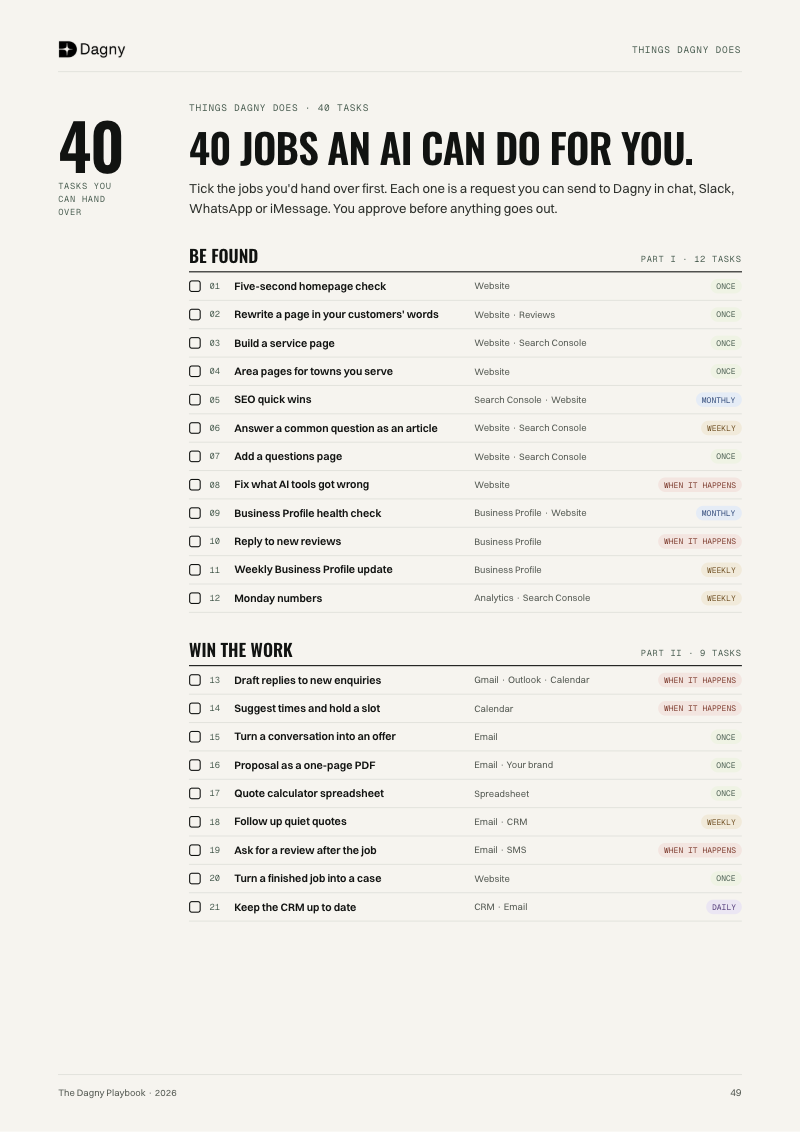
Take it with you
Free PDF · 51 pages
The whole playbook, in one PDF.
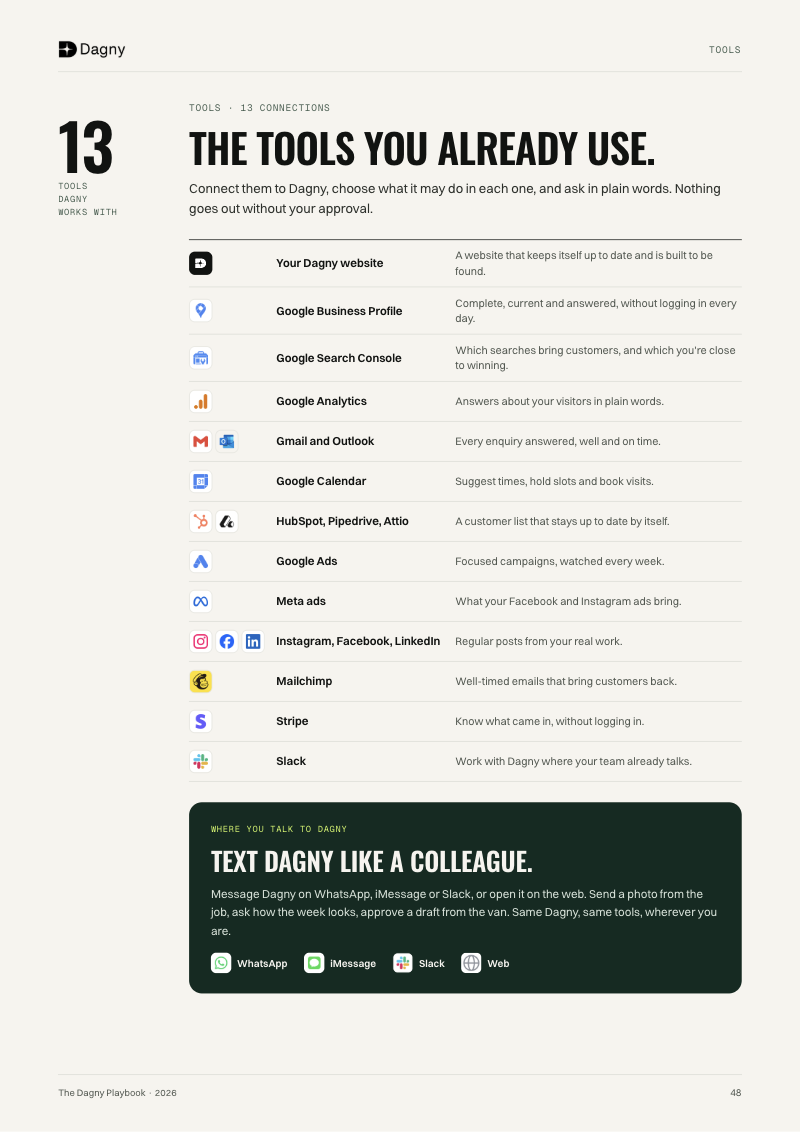
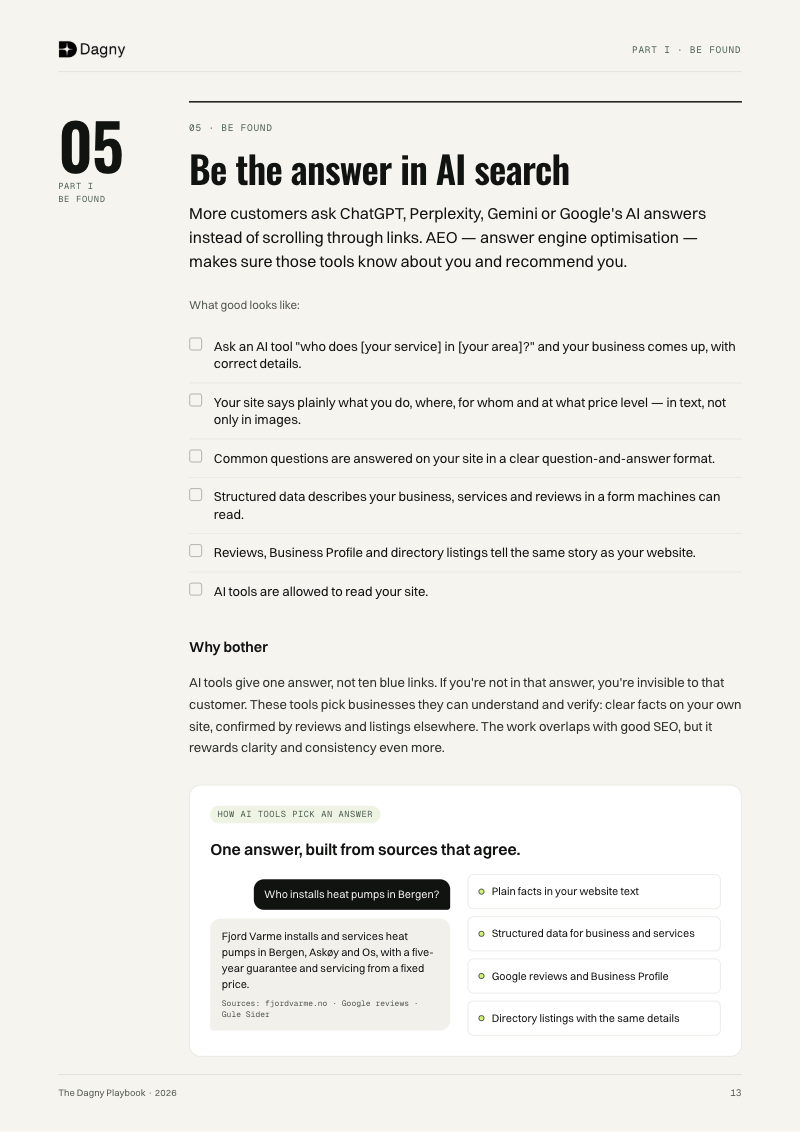
Four parts, 20 sections, the worksheets and the 40-task checklist. Read offline, print, or pass it on.51 pages to read offline, print, or pass on to your team.