Part III
Grow.
Growth comes from doing more of what already works, in the places your customers already are. Part III covers knowing your market, Google Ads, Meta ads and social media, email, and a content plan you can keep up.
13 · Grow
Know your market
Know who you compete with, what they promise, what they charge, and where they're weak. That's where you win.
What good looks like:
- You can name your five closest competitors and what each one is known for.
- You know how they price, or roughly what they charge.
- You know which of them advertise, and what they say in their ads.
- You know what their customers complain about in reviews.
- You can say in one sentence why a customer should choose you instead.
Why bother
Customers compare. If you don't know what they're comparing you with, you can't explain why you're the better choice. Competitors' reviews and ads are free research into what customers want and don't get.
How to do it
- Search for your main service in your area, and note who appears on Google, in the map results and in AI answers.
- Read their websites: who they speak to, what they promise, how they price.
- Check whether they run ads, and what the ads say.
- Read their one- and two-star reviews. Every complaint is an opening for you.
- Write down the gap: what customers want that nobody is doing well. Build your message around it.
“We're a quality company with great service.”
“The only electrician in Trondheim with a fixed price for EV chargers and installation within a week. Competitors quote hourly and book three weeks out.”
FAST ↑
You — the gap
FIXED PRICE
HOURLY →
Grey dots: competitors. Pick the two things your customers care about most.
14 · Grow
Google Ads that pay for themselves
Paid search works when the right person searches for exactly what you do, in your area, and lands on a page that answers them.
What good looks like:
- Each campaign covers one service in the area you actually work.
- Each ad leads to the matching service page, not the homepage.
- You track calls and enquiries from ads, not just clicks.
- Searches that waste money are excluded every week.
- You know what one enquiry costs, and what a won job is worth.
Why bother
Google Ads can bring enquiries tomorrow, but they burn money fast when they're broad, send people to the wrong page, or go untracked. Small, tight campaigns with good pages usually beat big budgets.
How to do it
- Start with one profitable service and one area.
- Choose search terms people use when they're ready to buy: "heat pump installer Bergen", not "heat pumps".
- Write ads that say the service, the place and one reason to choose you.
- Send each ad to the matching service page (section 3).
- Track calls and form enquiries as conversions.
- Every week, exclude searches that don't match what you do, and move budget to what brings enquiries.
one campaign for "plumber", all of Norway, sending everyone to the homepage.
"Emergency plumber Stavanger — here within two hours", sending people to the emergency plumbing page with a tap-to-call number.
1 · SEARCH
“bathroom renovation Stavanger”
2 · AD
Bathroom renovation in Stavanger — fixed price
3 · PAGE
The matching service page
4 · ENQUIRY
Tracked, with cost per enquiry
16 · Grow
Email your customers
Your past customers already trust you. A short, useful email a few times a year brings them back — and makes them recommend you.
What good looks like:
- You have a list of past customers who have agreed to hear from you.
- You send a short, useful email four to six times a year.
- Every email has one point and one action: book a service, see something new, pass it on.
- Emails are timed to the season: servicing before winter, gardens before spring.
- You can see who opened and who booked.
Why bother
Winning a new customer costs far more than bringing back an old one. Many service jobs repeat: servicing, cleaning, maintenance, seasonal work. A well-timed reminder brings in work that would otherwise go to whoever the customer found first.
How to do it
- Collect email addresses and permission when you finish a job.
- Plan four to six emails for the year around your seasons.
- Keep each one short: a useful tip, one offer or reminder, and one button.
- Send from a real person's name.
- Check who booked, and learn from it for the next one.
"Company news — Autumn edition" with six articles.
“Time to service your heat pump before winter. Book a slot in October and we'll check the outdoor unit for frost damage at no extra cost. [Book a service]”
- JAN
- FEBSpring booking
- MAR
- APRSeason tip
- MAY
- JUN
- JUL
- AUGBack-to-routine
- SEP
- OCTWinter servicing
- NOV
- DECThank you
17 · Grow
A content plan you'll keep
One useful thing a week, across your website, your profile and social, beats a burst of activity that stops after a month.
What good looks like:
- You have a simple plan for the next four weeks.
- Each week has one main piece: an article, a case, a tip or an offer.
- That piece is reused: on the website, the Business Profile, social media and email.
- Ideas come from real questions and real jobs.
- The plan is written down, not in your head.
Why bother
Consistency matters more than volume. Google, AI tools and customers all reward businesses that are visibly active and helpful over time. A plan that's small enough to keep is worth more than an ambitious one you abandon.
How to do it
- Collect ideas from customer questions, finished jobs and your seasons.
- Pick one main piece a week for the next month.
- Turn each piece into three: a page or article, a Business Profile update, a social post.
- Put the plan somewhere you'll see it.
- At the end of the month, keep what brought enquiries and replace the rest.
“Post every day on every platform.”
“Week 1: article on heat pump servicing. Week 2: case from the Askøy job. Week 3: winter tip. Week 4: October service offer.”
THIS WEEK’S PIECE
Case: the Askøy install
- Website caseProblem, work, photos
- Business Profile updateTwo lines, one photo
- Instagram postBefore and after
What comes next
Growth creates more to keep track of. Part IV is about staying on top of it with less effort: a weekly review, routines that run themselves, and your tools connected in one place.
Read Part IV — Stay on top →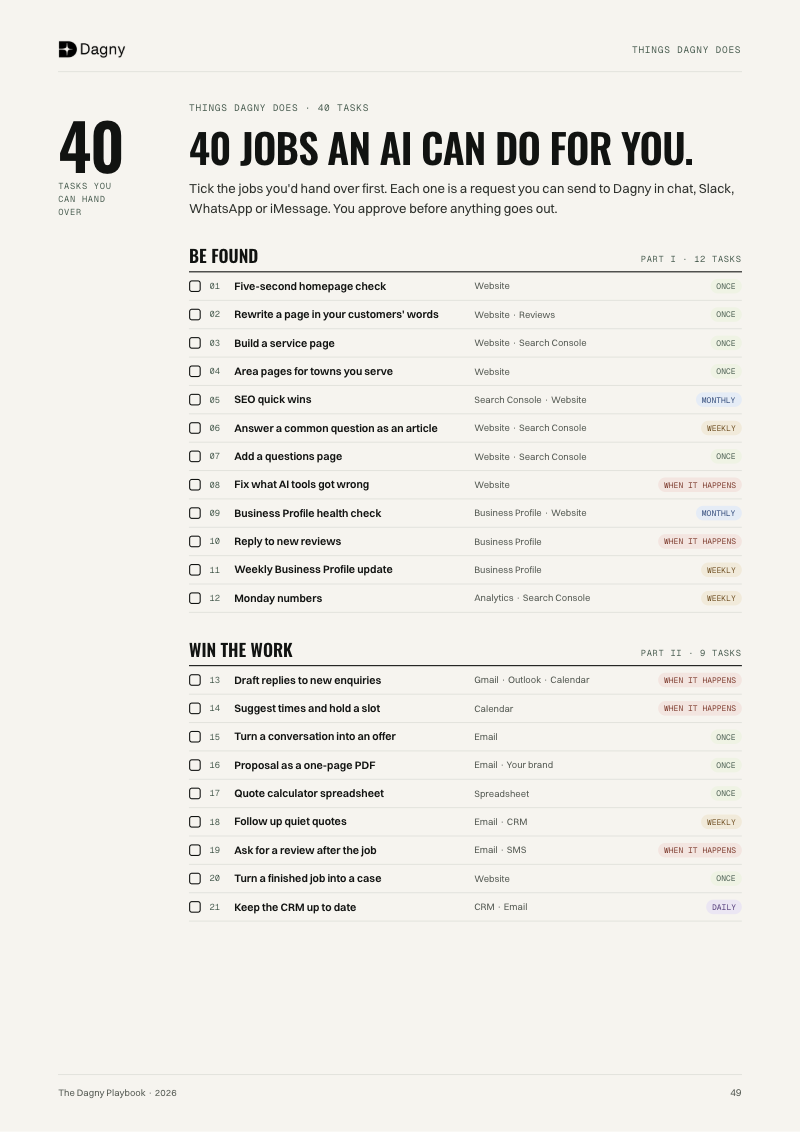
Take it with you
Free PDF · 51 pages
The whole playbook, in one PDF.
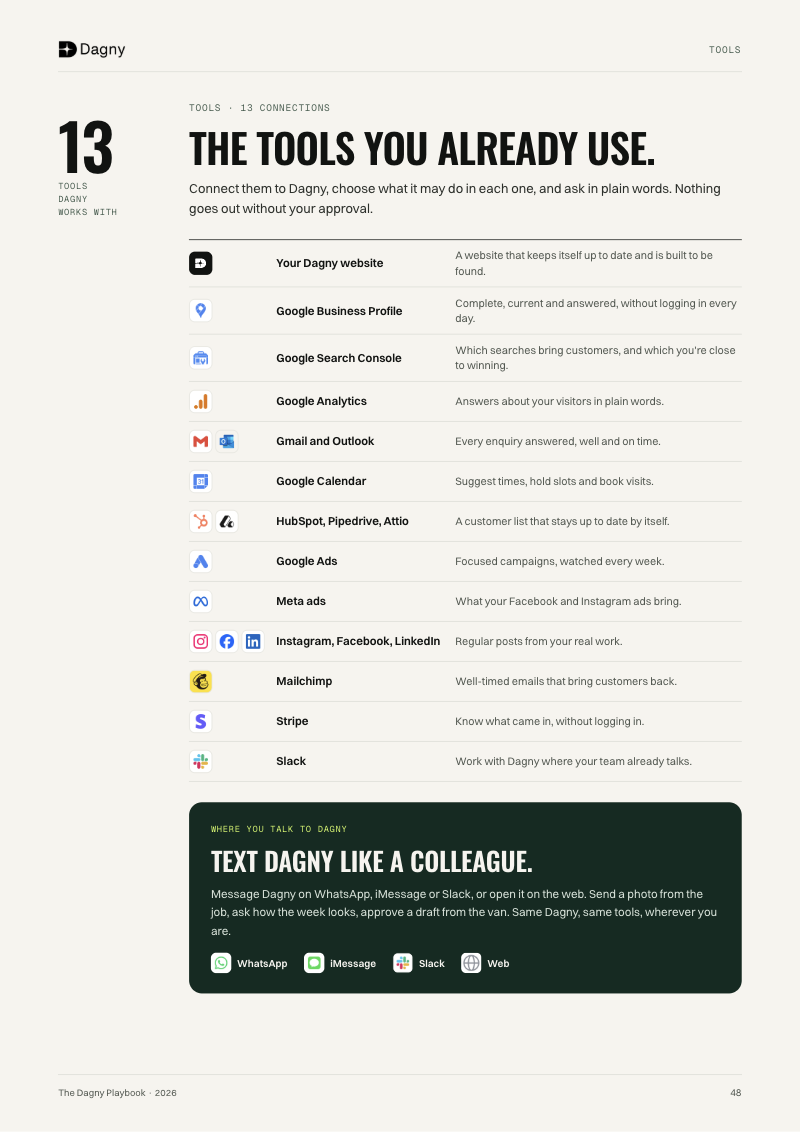
Four parts, 20 sections, the worksheets and the 40-task checklist. Read offline, print, or pass it on.51 pages to read offline, print, or pass on to your team.